


Too many Pilots. Not enough Flights.
That’s exactly how we feel seeing the excitement and the transformative promises AI holds for organizations. There is no denying the fact that most organizations are still in the experimentation or piloting phase.
Every major enterprise today is betting on AI which is no longer a back‑office enhancement but a primary vector for competitive advantage. However, the latest report by Gartner says, more than 40% of agentic AI projects are expected to be discontinued by 2027, derailed by rising costs, unclear business outcomes, and inadequate risk management.
Adding to the confusion is a surge of “agent washing,” which is nothing but rebranding the existing products like AI assistants, RPA systems, and chatbots as agentic solutions without delivering true autonomous capabilities. As enterprises navigate this hype cycle, the challenge is ensuring the AI investments translate into scalable, trustworthy, and measurable impact.
A new report reveals that 92% of companies plan to invest more in AI over the next 3 years. But 1% believe their investments have reached maturity.
Let’s understand why AI keeps falling short.
Why AI Keeps Falling Short?
Most companies are swayed by the shiny AI use cases, yet countless AI projects silently die in a frustrating limbo known as “purgatory”. The common causes are:
- Poor Data Readiness: This remains a fundamental barrier, as enterprises often operate with siloed, inconsistent, and low-quality data. Without reliable and well-integrated data, AI models struggle to deliver accurate and trustworthy outcomes, limiting their effectiveness.
- Complex Integrations: Enterprises often have complex, legacy IT environments that are not designed for AI integration. This further hinders AI adoption. Embedding AI into existing workflows requires significant effort; otherwise, AI insights remain unused, sitting in separate tools instead of influencing real decisions or automation.
- Fragmented AI initiatives: In most large enterprises, AI does not emerge as a coordinated capability; it erupts as a collection of independent experiments. With multiple disconnected pilots and use cases that lack a unified strategy, AI initiatives are bound to fail. Teams in different departments solve the same problems from scratch, procure overlapping vendors, and build redundant infrastructure because they have no visibility into what colleagues have already built.
- Governance Vacuum: When an AI system moves from pilot to production, a new class of risk emerges that most organizations have no machinery to manage. Who is accountable when the model makes a consequential error? Who decides when it needs to be retrained, updated, or withdrawn? Without clear policies and oversight, organizations face challenges in building trust, ensuring accountability, and maintaining responsible AI practices.
The Pilot Trap vs. The Assurance Ecosystem
The Pilot Trap and the Assurance Ecosystem aren’t two points on a maturity scale. They are two fundamentally different organizational philosophies about what AI is for.
| The Pilot Trap
How most enterprises currently operate |
The Assurance Ecosystem
How mature AI organizations operate |
| Sporadic Experiments
Projects are launched reactively in response to a vendor demo, a competitor’s announcement, or a board-level mandate to “do something with AI. The question is never “should we?” — only “can we? But there is no coherent selection logic.
|
Scalable Factory
Initiatives are selected against a rigorous value framework. Each deployment adds to shared institutional infrastructure. The question is always “should we?” — and the answer must be backed by a business case before a single line of code is written.
|
| Compliance Risk
Governance is treated as a post-launch audit; something legal and compliance teams do to AI projects, not something embedded within them. The result: projects that pass internal review only to fail regulatory scrutiny, or worse, cause reputational harm at scale.
|
Guaranteed Security
AI requires stronger security than traditional software because it can unintentionally expose sensitive data through latent storage, prompt leakage, or hallucinated outputs. Here, governance is an architectural layer embedded into the system from day one, not retrofitted after. |
| Uncertain ROI
Success metrics are defined loosely or not at all. Teams measure what’s easy to measure, i.e. model accuracy, latency, uptime, rather than what matters: revenue impact, cost reduction, or time saved per user. |
Predictable Outcomes
ROI is defined before deployment, measured continuously during operation, and reported transparently to stakeholders.
|
Saksoft Approach: Three Pillars of Enterprize Assurance
If the failure of AI at scale is a system problem, then the solution cannot be a better model or a bigger dataset. It must be a new operating paradigm.
Saksoft’s Three Pillars of Enterprise Assurance represents a structured approach to transform AI initiatives from a set of fragmented experiments into a scalable, trusted, and value-generating enterprise capability.
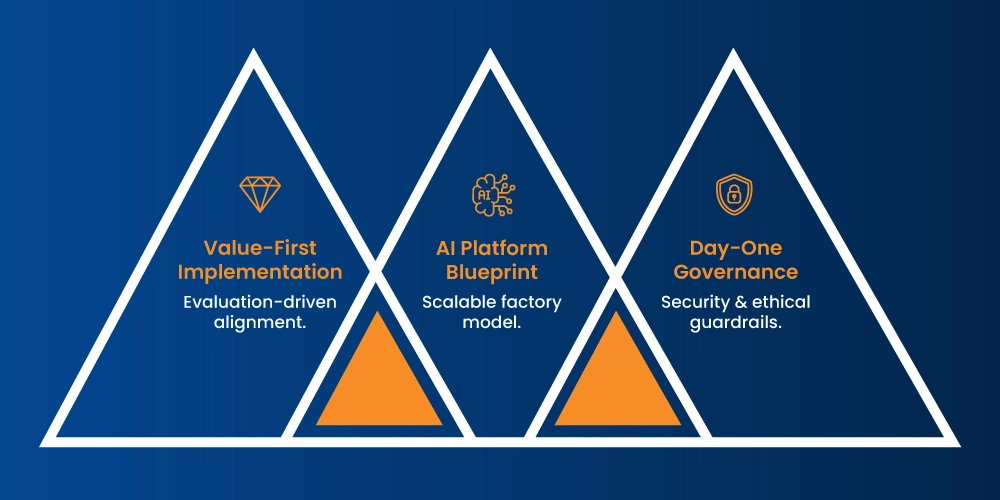
Pillar 1: Value-First Implementation
Shift from Tech-Push to Value-Pull
This is where most AI transformations fail before they start. Let’s understand this with the funnel model. Raw ideas pour in at the top, and what comes out of the bottom is the only thing that should make it through — the high-value business outcomes. And the filter in the middle is ROI & Impact Assessment.
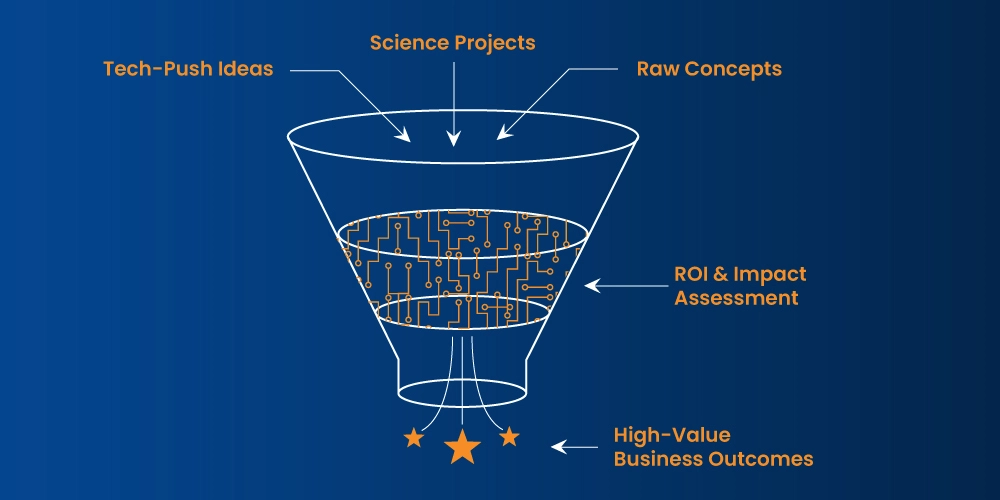
- Rigorous pre-assessment of ROI
Before a single model is trained or a single API is called, you need a credible financial and operational case for why this initiative matters.
- Continuous evaluation metrics
Not just a pre-launch check, but ongoing measurement. Is the AI still delivering value at month 3? Month 6? If not, what’s degrading?
- Elimination of low-utility projects
The most underrated discipline in enterprise AI. Being willing to kill a pilot that isn’t delivering, is what separates mature AI organizations from perpetual experimenters.
Why This Matters?
Value-Pull reverses the power dynamic. Instead of technology teams pitching capabilities to reluctant business stakeholders, business problems are pulling AI solutions toward them. This creates internal demand, which is the only kind of adoption that actually scales.
Pillar 2: Scalable AI Platform Blueprint
The Central AI Factory
One of the most common failure modes in enterprise AI is where different departments like HR, Finance, Sales, and Operations – each build their own AI tools, their own data pipelines, their own vendor relationships.
The result? Four times the cost. Zero institutional learning. No compounding advantage.
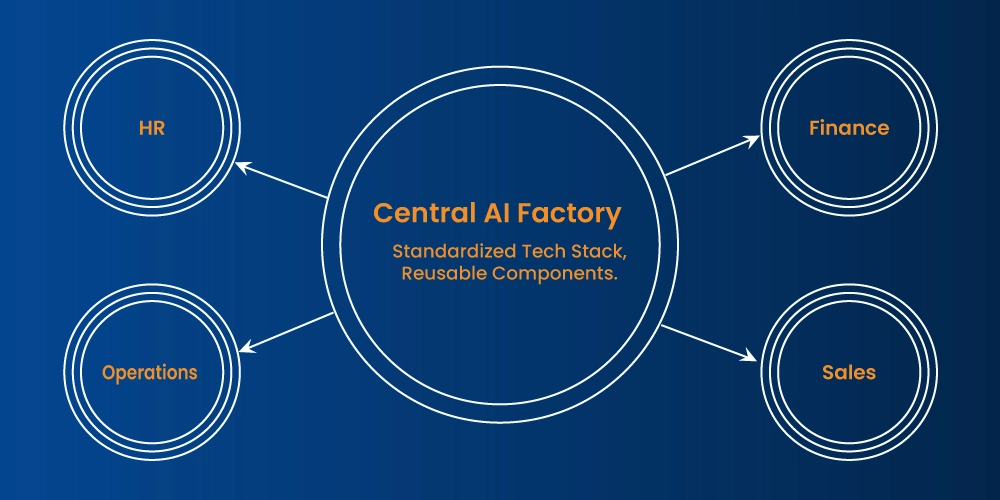
The AI Factory model solves this with 3 non-negotiables:
- Standardization:
A unified tech stack across the enterprise. When every team builds on the same foundation, integrations become predictable and maintenance costs collapse. - Reusability
Build once, deploy everywhere. A customer-intent classification model built for Sales shouldn’t be rebuilt from scratch for Operations. Components become enterprise assets, not departmental experiments. - Scalability
Enterprise-ready architecture from day one. Not “we’ll refactor this when it goes to production” — actually production-grade from the first deployment.
Why This Matters?
The Central AI Factory is the operating model that connects business functions to a central intelligence layer, enabling AI to scale horizontally across the enterprise. Also, this treats AI infrastructure as shared capital, not departmental budget.
Pillar 3: Governance from Day One
The final and often most underestimated barrier to AI scale is trust. The conventional wisdom is – governance slows AI down. Security reviews, compliance checks, ethics audits — all create friction and delays. The assurance-driven reframe is exactly the opposite: governance built from day one is what allows you to move fast without breaking things that matter.
Here, three key priorities are:
- Ethical AI:
Fairness and bias prevention – as a technical discipline embedded in model design, training data, and output monitoring. - Compliance:
GDPR and regulatory adherence built into the architecture. So that, when regulators come knocking, you need documentation, not damage control. - Security:
IP and data protection. As AI systems handle increasingly sensitive data, security isn’t just about preventing breaches; it’s about maintaining the trust of every stakeholder in your ecosystem.
Why This Matters?
Every AI deployment that fails for governance reasons costs 5–10× more to remediate than it would have to prevent. The math is simple: governance is cheap early, expensive later. Organizations that treat compliance as a built-in feature and not a constraint, move faster, scale more easily, and avoid costly surprises.
The B.O.T. Journey: Build. Operate. Transfer.
Frameworks are only as good as their implementation model. The best AI transformations transfer knowledge, not just deliverables.
The goal is not to create a client who needs ongoing consulting support indefinitely. The goal is to make them self-sufficient so that when the engagement ends, the organization should be stronger, more confident, and able to move forward on its own.
That’s a fundamentally different incentive structure and a much more trustworthy one.
Saksoft’s AI Co-Innovation Lab: Delivered 50% Faster AI Innovation
Frameworks earn credibility only when they survive contact with real enterprise complexity.
A leading global technology distribution enterprise partnered with Saksoft to setup an AI Co-Innovation Lab to move beyond isolated AI pilots and enable scalable adoption. They were running disconnected AI pilots, managing fragmented data pipelines, and watching promising experiments fail to cross the production threshold.
Saksoft opted for a structural approach:
- Built a unified data foundation to accelerate AI-ready data across the enterprise
- Established a scalable AI factory with reusable components and standardized pipelines
- Deployed high-impact agentic AI use cases across supply chain and customer functions
- Accelerated development and innovation cycles through AI-driven engineering accelerators with 100% intellectual property sovereignty.
- Enabled long-term self-sufficiency with a vendor-agnostic, BOT-led capability transfer model
As a result, we were able to achieve 60% faster data readiness and 50% faster AI innovation cycles. They were the compound returns of building a system where each deployment makes the next one faster.
How to Step Out of Pilot Purgatory
Escaping Pilot Purgatory isn’t about running better experiments. It’s about building the organizational architecture that makes experimentation unnecessary, because you have a factory that delivers outcomes predictably, securely, and at scale.
What you need to do?
- Assess current AI maturity
Know where you stand before you decide where you’re going. Most organizations overestimate their readiness and underestimate their structural gaps.
- Identify the pilot that proves the factory model
Not just any pilot, but one specifically designed to validate the scalable infrastructure. The right first project is a proof-of-concept for the system, not just the use case.
- Establish governance guardrails:
The cheapest and most effective time to do this is before you scale anything; not after your first incident.
Escaping Pilot Purgatory isn’t a technology challenge; it’s a strategic choice to trade the comfort of experimentation for the rigour of a system. With Saksoft’s assurance-driven approach, every decision is grounded in structure, every deployment is supported by governance, and every outcome is tied to clear, measurable business value.
Where does your organization sit on the pilot-to-factory spectrum? Request your AI Readiness Framework.