


For decades, the partnership between an enterprise and an IT services firm was defined by a fundamentally stable logic: You bring the capacity; we measure the effort. It was a partnership built on predictability—Effort as the primary signal of value.
But the environment has moved on. The expectations of the C-Suite have pivoted—not incrementally, but structurally. The most powerful friction point I see today isn’t a lack of AI capability. It is a Maturity Gap sitting in the middle of almost every enterprise.
The Executive Paradox: The Delivery Fabric Failure
On one side are powerful AI models capable of reasoning, classifying, and acting with implausible sophistication. On the other side are enterprise operations running on legacy workflows built over decades—approval chains, compliance requirements, and data governance policies never designed for autonomous agents.
The result? The pilot succeeds. The scale-up stalls.
This isn’t caused by the AI. It is caused by inserting a high-velocity intelligent agent into a static, legacy delivery fabric. When the operating environment transforms, the surrounding model cannot remain unchanged.
The Structural Shift: From Execution to Judgment
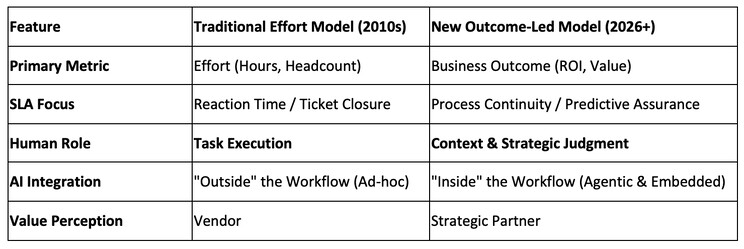
The old equation was simple: Effort (Input) = SLA Adherence (Output). AI reshapes this equation by changing what valuable human effort looks like.
In an AI-augmented environment, the highest-value human contribution is no longer execution; it is Judgment. Context. Strategic Interpretation. It is the ability to ask the correct question of a system that can now answer thousands of them simultaneously. This means the delivery model itself must reorganize around a new center of gravity:
The Strategic Pivot: From Effort-Based to Outcome-Led
Gaining Mindshare: What a Genuinely Outcome-Led Partnership Looks Like
A real outcome-led partnership has three definitive markers that distinguish it from the standard corporate brochure talk:
- Measurement Moves Upstream: Instead of measuring how quickly an incident is resolved, we measure how few incidents occur. We track business process continuity over ticket closure rates.
- AI is the Workflow, Not an Add-on: True multiplier effect only happens when AI agents are embedded in the fabric—governed by compliance and security guardrails. When they sit outside, they just create more work.
- Shared Accountability for the System: This calls for a deeper commercial trust and commercial structure—shifting the relationship from a “vendor” to a “strategic advisor.”
Here, we ask our first question: If your AI pilot can’t explain its own decision-making process within your data governance framework, it isn’t ready for production. Are your AI guardrails strong enough to scale safely?
The best enterprises are already selecting partners based on a new standard: Show me outcomes, not activity.
At Saksoft, we have reorganized our entire delivery structure to meet this standard. We have placed AI at the center of our engineering, QA, and support operations, built cross-functional PODs that own business outcomes, and invested heavily in the connective tissue—data integration and governance architectures—that makes AI actually work at scale.
The opportunity is real, and the cost of getting it wrong—wasted investment and eroded competitive position—is significant.
The harder question must be asked first: How do we build a delivery model worthy of this intelligence? That is the question we are in the business of answering.
The 3-Question “Delivery Model Check” for Your Next AI Project:
- The Measurement Test: Are we still paying for developer hours, or are we paying for a 15% reduction in billing inquiries?
- The Integration Test: Is our AI agent executing tasks directly inside MS Teams/Slack, or is it a separate “chat window” in a browser?
- The Context Test: If the AI agent encounters an exception, does it know how to flag it for the human in the loop, or does it try to resolve it with no context?
Final Thought:
Most conversations about enterprise AI stall at the wrong layer. They debate model selection, vendor comparison, and build-versus-buy — while the real bottleneck sits untouched: a delivery model that was never designed to carry intelligent systems at scale.
The enterprises that will lead the next decade are not necessarily those with the most sophisticated AI. They are those with the organizational maturity to absorb it — delivery models redesigned around outcomes, governance architectures built for speed without sacrificing control, and partnerships anchored in shared accountability rather than activity reports.
Technology is no longer the constraint. The question is whether the model surrounding it is ready to carry weight.
At Saksoft, that is the problem we have chosen to solve — not just for our own operations, but for every enterprise partner we work with. Because that is the standard we are building toward. And in our perspective, it is the only standard worth building toward.
Dhiraj Mangla, Chief Customer Officer, Saksoft